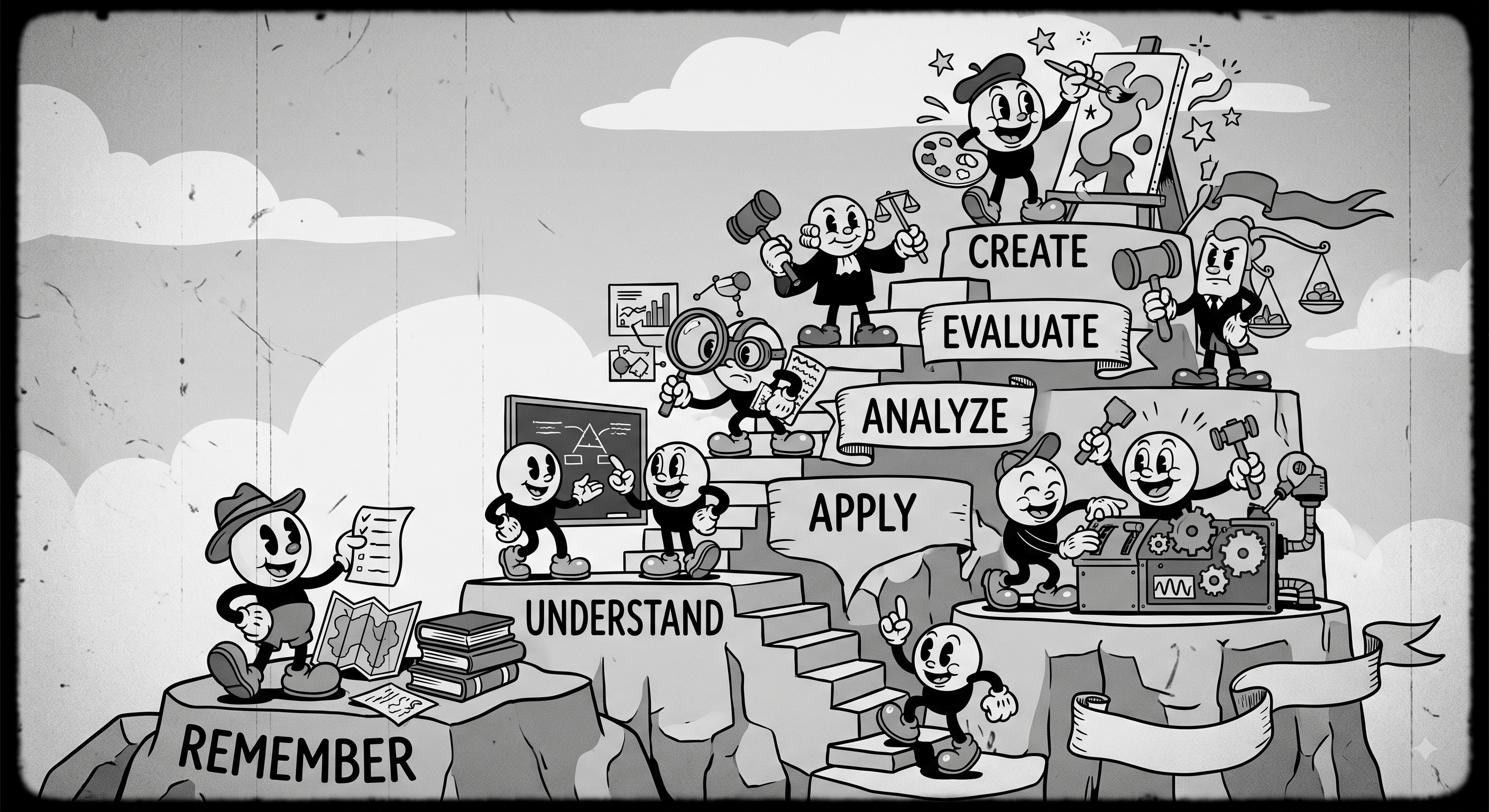
Originally developed in 1956, Bloom’s Taxonomy is a hierarchical framework used to categorise educational goals. It moves from basic foundational knowledge up to complex, creative thought. Here is how I think this framework can be applied to teach myself Chinese at a slow pace. Chinese has thousands of characters, four distinct tones, and a completely different writing system from Vietnamese. It is overwhelming and intimidating. As a beginner who has loosely learnt how to read Pinyin, I have realised that applying Bloom’s Taxonomy to my own self-study journey can be a good way to track if I have any progress.
1. Remembering: Can I recall the core building blocks?
At the base level, progress means moving from active drilling to instant recognition. I track my progress by assessing whether I can recall Pinyin, the four tones, and basic vocabulary (focusing on phrases up to three syllables as anything more than that might mess with my brain at this beginner stage) without consulting written notes. For example, if I can pronounce “hē kā fēi” aloud and connect it to the concept “drink coffee” spontaneously, I have secured this benchmark.
2. Understanding: Do I grasp the underlying mechanics?
Progression here is measured by comprehension rather than rote memorisation. I gauge my understanding by seeing if I can anchor new concepts to existing knowledge, such as connecting Chinese terms to Sino-Vietnamese cognates (like kōng qì to không khí). If the logic behind the vocabulary makes sense, I know I have passed the recall stage.
3. Applying: Can I use the language in real time?
To monitor application, I track whether I can transfer textbook knowledge into spontaneous habits. Progress at this stage is evident when I can narrate simple actions while doing chores, send basic greeting messages on language exchange apps, or correctly format a basic sentence without pausing to check grammar rules.
4. Analysing: Can I dissect how the language works?
Progress here involves stepping back to act as my own instructor. I monitor my analytical ability by checking if I can break down sentence patterns and compare them to English or Vietnamese. For instance, recognising that Chinese relies on time particles rather than verb conjugation shows a deeper structural awareness.
5. Evaluating: Can I accurately critique my own output?
Without a formal teacher, self-evaluation is the primary checkpoint for quality control. I measure progress at this stage by recording my spoken Chinese and comparing it directly against native audio recordings. Spotting my own tonal mistakes or missing aspirations proves that my ear is becoming attuned to correct usage.
6. Creating: Can I express original thoughts?
The final indicator of progress is independent synthesis. Even as a beginner, reaching this level means stepping away from memorised scripts to construct unique thoughts. Writing a short daily journal entry—such as “Today is Monday. I am tired. I drank coffee”—signals that I have successfully converted passive knowledge into active, creative communication.